BillSplittr

OVERVIEW

BillSplittr is an expense sharing app, born from an extensive research project at my masters. A year after finishing this project, I decided to look again at the data I found with my team to design prototype screens for it using Figma. Our goal was to compare three different apps on the market with qualitative and quantitative methods, gathering feedback on desirable features and pain points to design the ultimate expense sharing app. This was a great exercise for my research skills, allowing me to get familiar with different techniques.
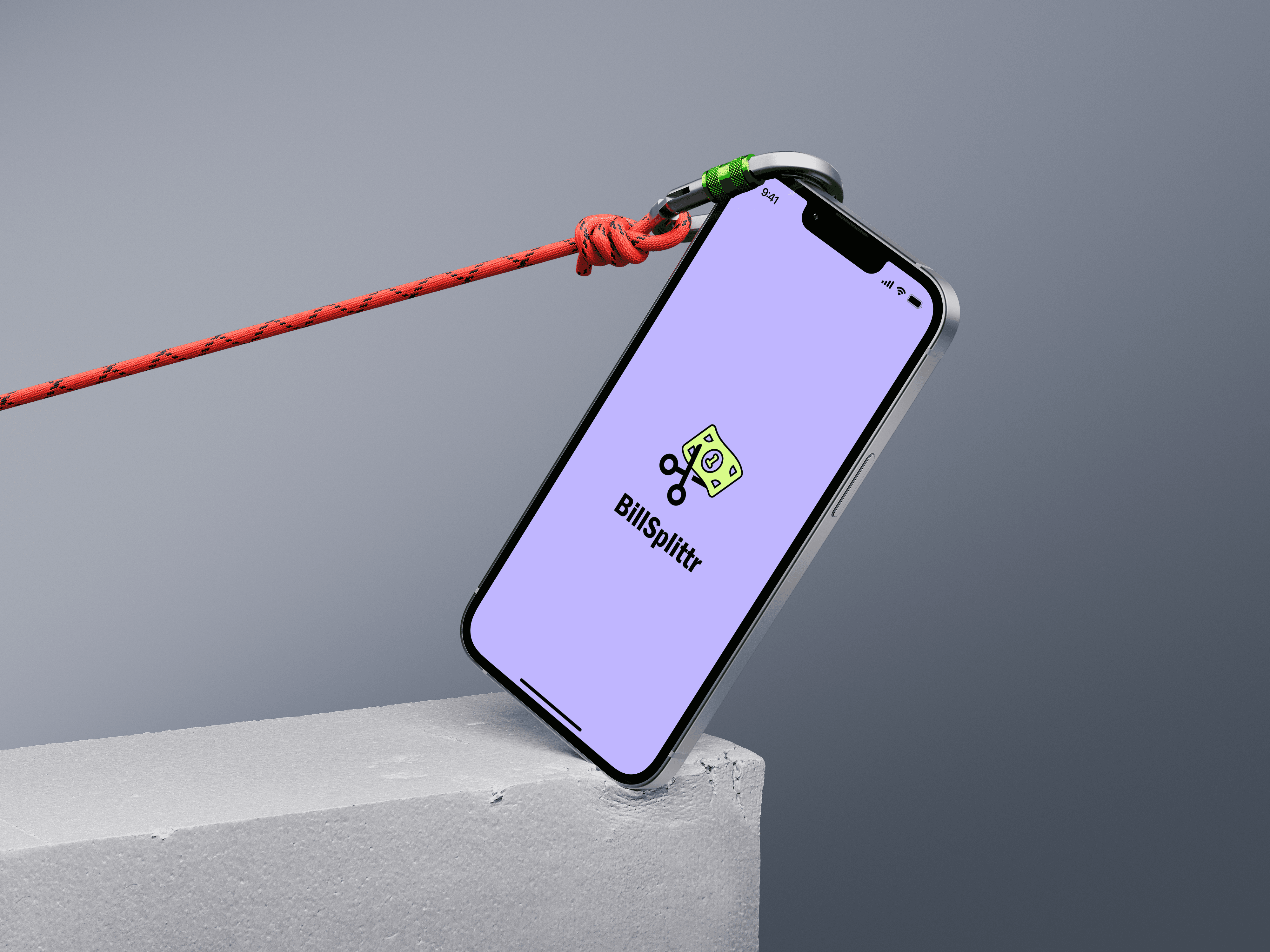
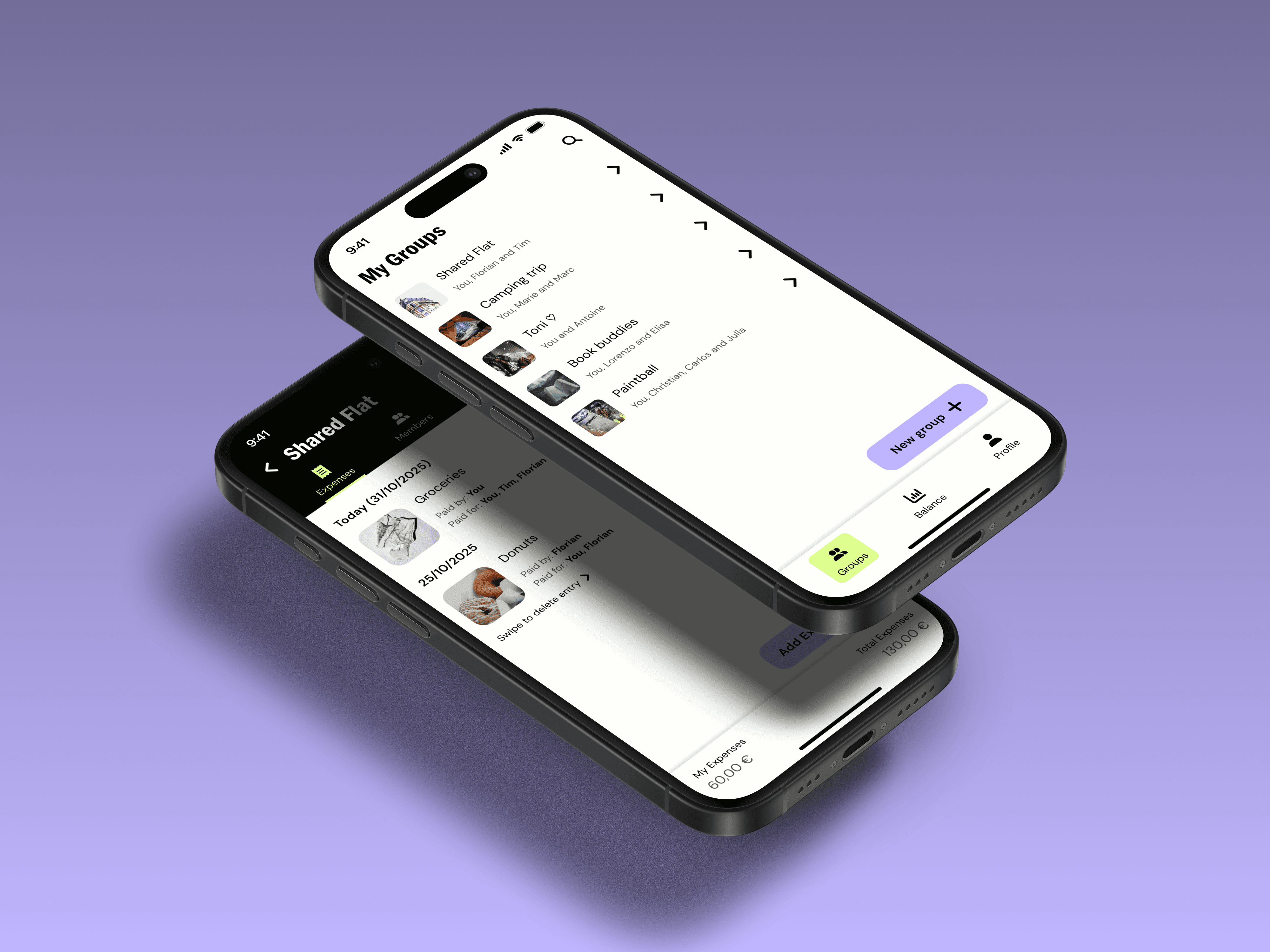
a phone with the billsplittr app
Image of 3 pixelated flat icons

TIMELINE

2023-
2024

5 Months

ROLES

UX Researcher
UX Designer
UI Designer

TOOLS

Figma
AttrakDiff
Excalidraw

CLIENT

University project

COLLABORATORS

4 other researchers

Pre-Research

Our first step was to choose three different expense sharing app to use as competitors. We used downloads and the functions these apps offered as criteria. We settled on three: Tricount, Splitwise and Settle Up.

We also came up with three possible user flows for this kind of app:

  1. Creating a group

  2. Adding an expense

  3. Reimbursement of an expense

Research

After defining user flows, we moved on to the actual research part of our project. We used the following techniques:

  1. Heuristic analysis, a qualitative testing technique.

  1. User interviews.

  2. Quantitative testing.

  3. A design thinking workshop, to get new ideas about our app independently from competitors.

Heuristic Evaluation is a qualitative testing method that allows to review products following some relevant usability principles.

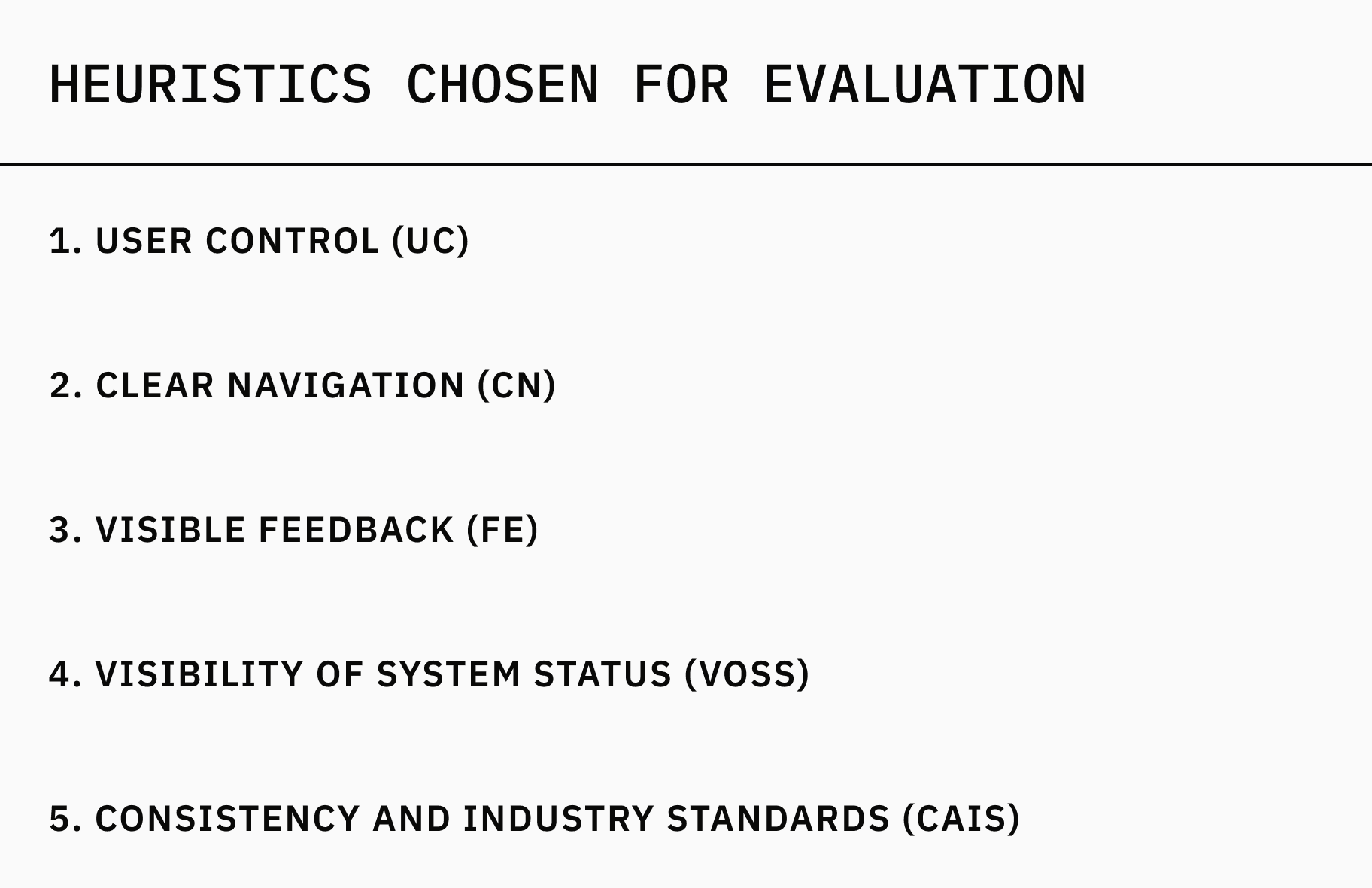
In this case, we picked five heuristics (in the table on the right) based on our user flows and asked five experts (professors from our study course) to give a score from 0 to 10 for each principle to the different user flows of every app.

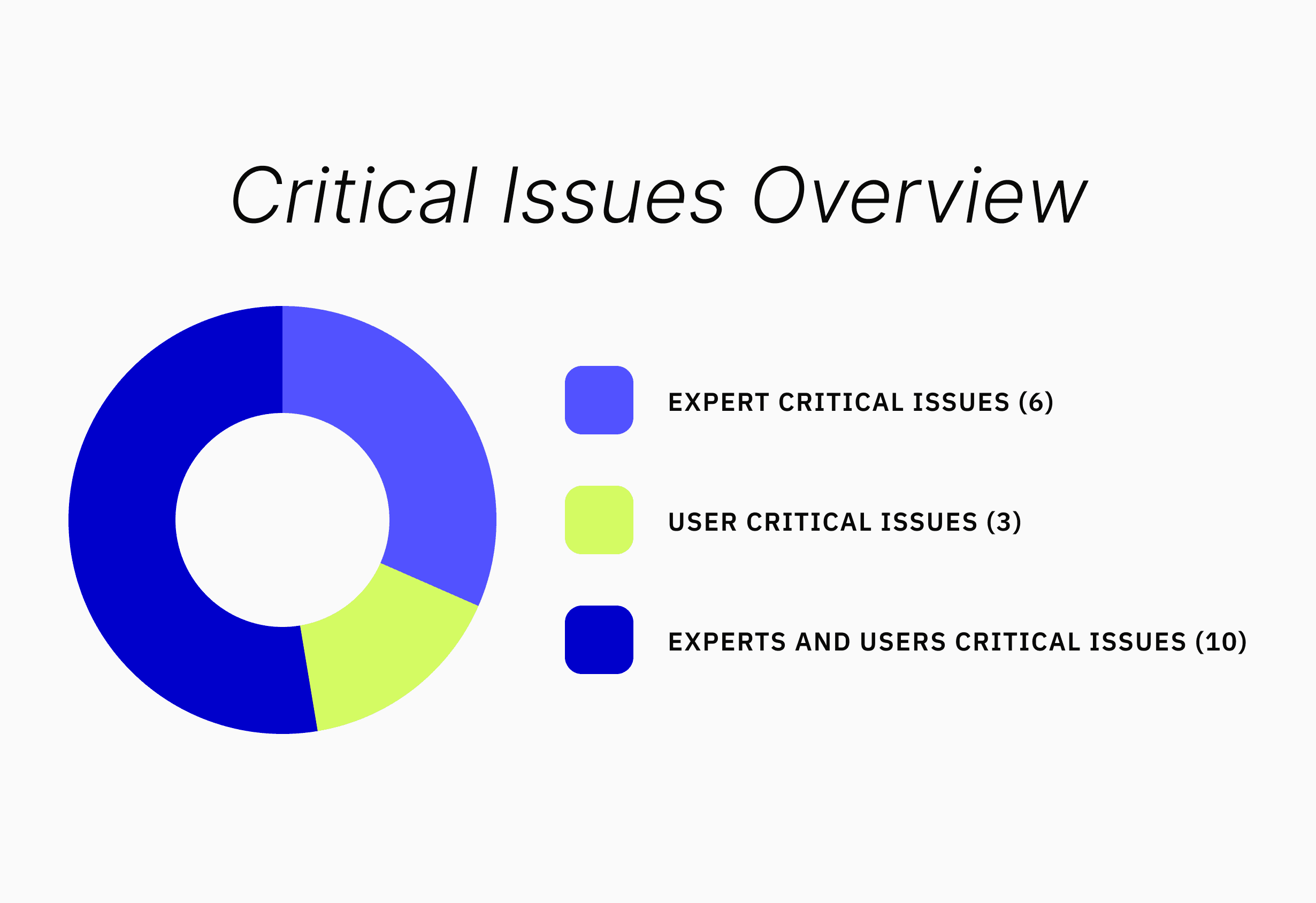
During the Heuristic Evaluation, our team of experts could also report some critical issues (expert critical issues) in each app, to allow us to avoid these mistakes when designing our prototype.

After doing the Heuristic Evaluation, a similar method was followed with user interviews. Through this process, we got a second list of critical issues (user critical issues).

There was a significant overlap between the user’s issues and the experts’ issues.

During these interview sessions, we also gathered quantitative data:

  1. Effectiveness - How many people could complete the user flow successfully (in percentage).

  2. Efficiency - How much time was needed to complete the user flow successfully and with how many clicks.

  3. AttrakDiff scores - An online questionnaire asking Likert scale questions about every user flow to measure three different parameters.


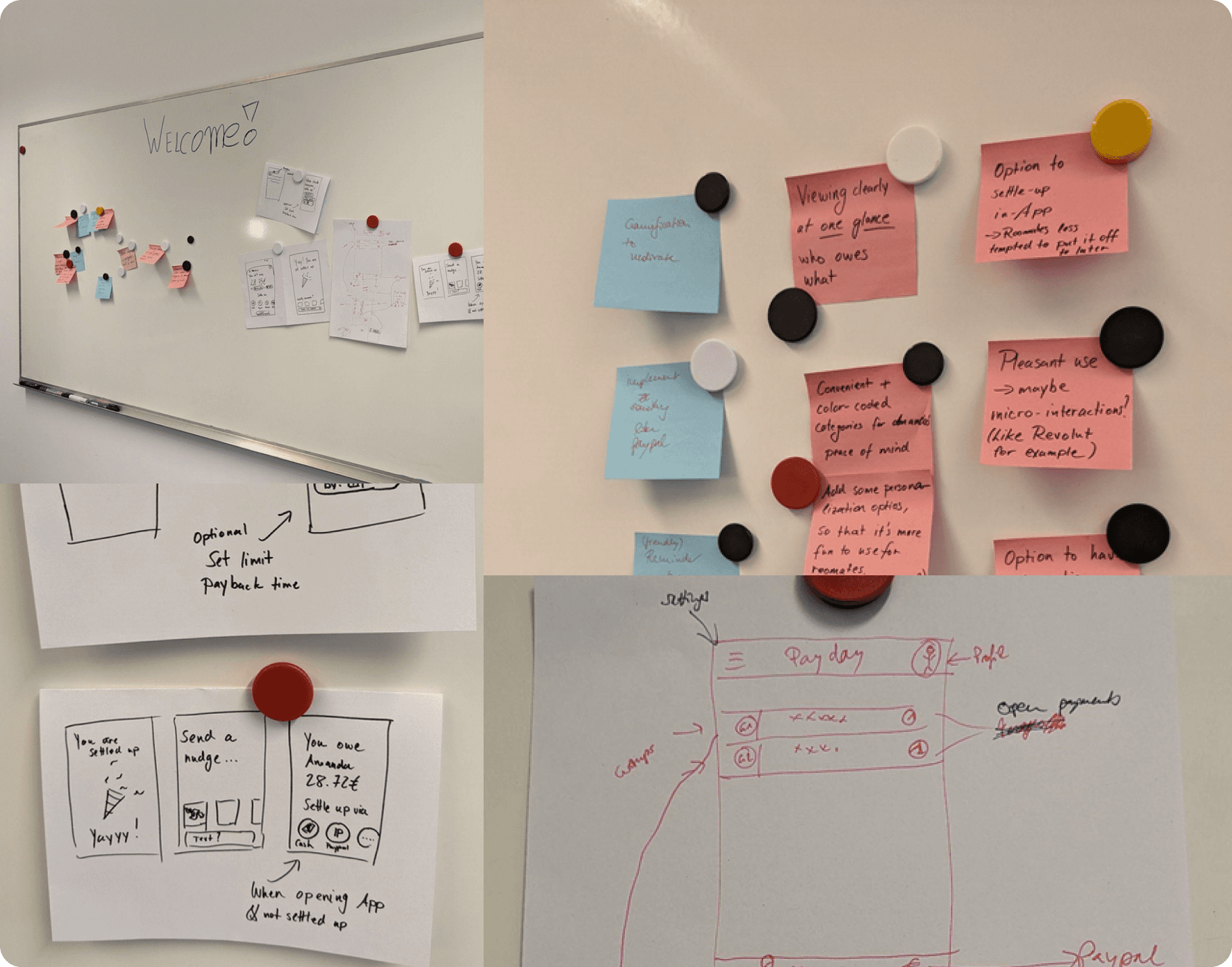
Lastly, we conducted a design thinking workshop, in which we got feedback from two external participants in a guided interview setting. The focus was developing additional user-centered solutions with our participants.

Insights

Main Insights


  1. From Heuristical Analysis and qualitative research:

    → List of critical issues to solve

  2. From Heuristical Analysis and quantitative research:

    → Tricount has to be used as inspiration for user flow 1 and

    → Splitwise has to be used as inspiration for user flow 2 and 3

  1. From Heuristical Analysis and quantitative research:

    → Tricount has to be used as inspiration for user flow 1 and

    → Splitwise has to be used as inspiration for user flow 2 and 3


  1. From the Design thinking workshop:

    → Add a quick way to pay debts and gamify the settling up experience

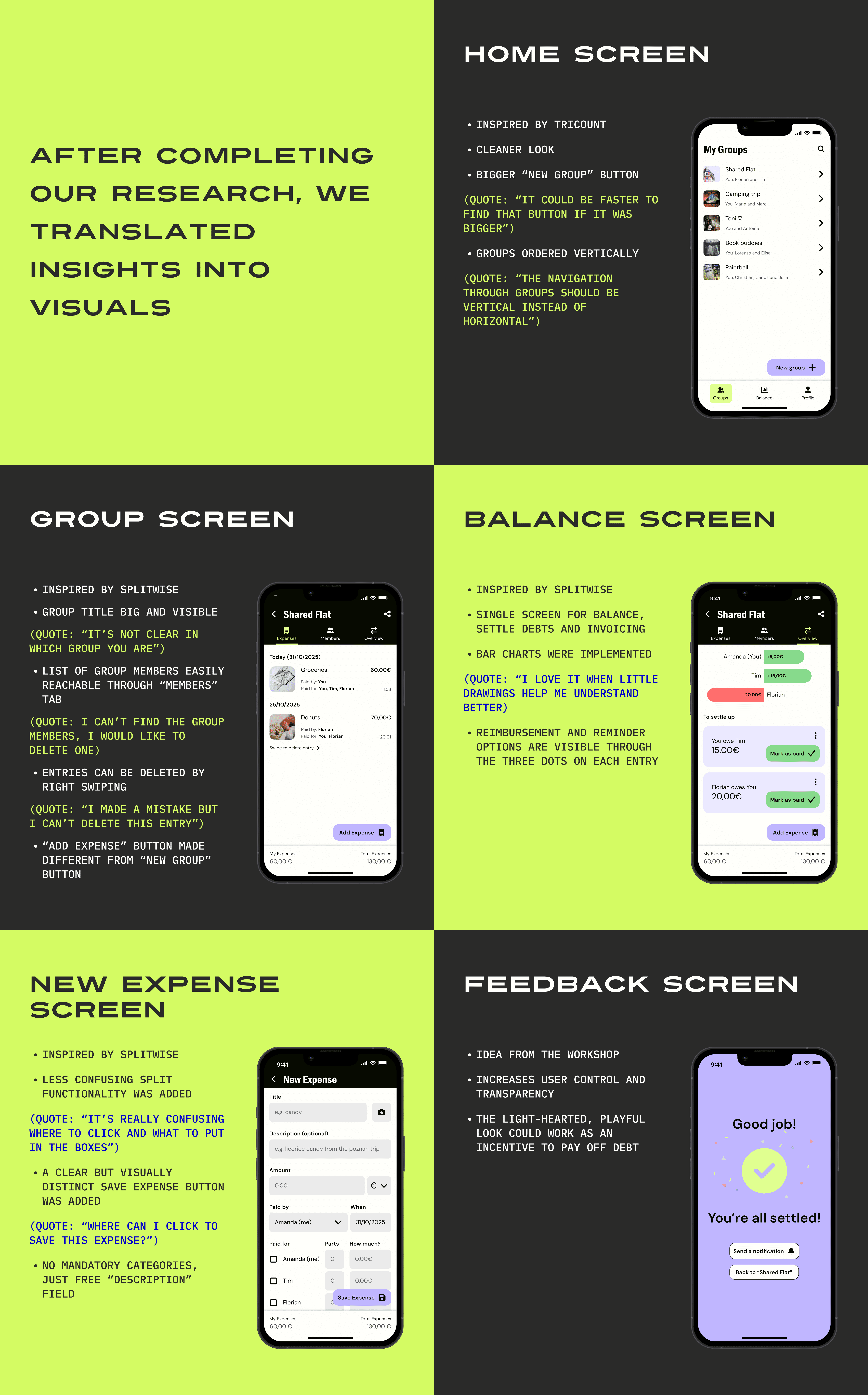
Wireframes hi-fi

Takeaways

This project was really hard and thoroughly tested our skills and our patience: some research techniques didn’t give us the results we hoped for and we needed to keep testing to understand which app was the better competitor in which field. An important takeaway we got was to don’t get demorialized and keep trying different research techniques if some of them don’t work.

I want to express gratitude to my professor, Eva Wiese, and my colleagues Nani, Yusra, Louise and Coralie.

LET'S GET IN TOUCH ✷

VITTO.BUZZONI@PROTON.ME

VITTORIO BUZZONI ©2025

2:14:47 PM

Smooth Scroll
This will hide itself!

BillSplittr

OVERVIEW

BillSplittr is an expense sharing app, born from an extensive research project at my masters. A year after finishing this project, I decided to look again at the data I found with my team to design prototype screens for it using Figma. Our goal was to compare three different apps on the market with qualitative and quantitative methods, gathering feedback on desirable features and pain points to design the ultimate expense sharing app. This was a great exercise for my research skills, allowing me to get familiar with different techniques.
a phone with the billsplittr app
Image of 3 pixelated flat icons

TIMELINE

2023-
2024

5 Months

ROLES

UX Researcher
UX Designer
UI Designer

TOOLS

Figma
AttrakDiff
Excalidraw

CLIENT

University project

COLLABORATORS

4 other researchers

Pre-Research

Our first step was to choose three different expense sharing app to use as competitors. We used downloads and the functions these apps offered as criteria. We settled on three: Tricount, Splitwise and Settle Up.

We also came up with three possible user flows for this kind of app:

  1. Creating a group

  2. Adding an expense

  3. Reimbursement of an expense

Research

After defining user flows, we moved on to the actual research part of our project. We used the following techniques:

  1. Heuristic analysis, a qualitative testing technique.

  1. User interviews.

  2. Quantitative testing.

  3. A design thinking workshop, to get new ideas about our app independently from competitors.

Heuristic Evaluation is a qualitative testing method that allows to review products following some relevant usability principles.

In this case, we picked five heuristics (in the table on the right) based on our user flows and asked five experts (professors from our study course) to give a score from 0 to 10 for each principle to the different user flows of every app.

During the Heuristic Evaluation, our team of experts could also report some critical issues (expert critical issues) in each app, to allow us to avoid these mistakes when designing our prototype.

After doing the Heuristic Evaluation, a similar method was followed with user interviews. Through this process, we got a second list of critical issues (user critical issues).

There was a significant overlap between the user’s issues and the experts’ issues.

During these interview sessions, we also gathered quantitative data:

  1. Effectiveness - How many people could complete the user flow successfully (in percentage).

  2. Efficiency - How much time was needed to complete the user flow successfully and with how many clicks.

  3. AttrakDiff scores - An online questionnaire asking Likert scale questions about every user flow to measure three different parameters.

Lastly, we conducted a design thinking workshop, in which we got feedback from two external participants in a guided interview setting. The focus was developing additional user-centered solutions with our participants.

Insights

Main Insights


  1. From Heuristical Analysis and qualitative research:

    → List of critical issues to solve


  1. From Heuristical Analysis and quantitative research:

    → Tricount has to be used as inspiration for user flow 1 and

    → Splitwise has to be used as inspiration for user flow 2 and 3


  1. From the Design thinking workshop:

    → Add a quick way to pay debts and gamify the settling up experience

Wireframes hi-fi

Takeaways

This project was really hard and thoroughly tested our skills and our patience: some research techniques didn’t give us the results we hoped for and we needed to keep testing to understand which app was the better competitor in which field. An important takeaway we got was to don’t get demorialized and keep trying different research techniques if some of them don’t work.

I want to express gratitude to my professor, Eva Wiese, and my colleagues Nani, Yusra, Louise and Coralie.

LET'S GET IN TOUCH ✷

VITTO.BUZZONI@PROTON.ME

VITTORIO BUZZONI ©2025

2:14:47 PM

Smooth Scroll
This will hide itself!

BillSplittr

OVERVIEW

BillSplittr is an expense sharing app, born from an extensive research project at my masters. A year after finishing this project, I decided to look again at the data I found with my team to design prototype screens for it using Figma. Our goal was to compare three different apps on the market with qualitative and quantitative methods, gathering feedback on desirable features and pain points to design the ultimate expense sharing app. This was a great exercise for my research skills, allowing me to get familiar with different techniques.
a phone with the billsplittr app
Image of 3 pixelated flat icons

TIMELINE

2023-
2024

5 Months

ROLES

UX Researcher
UX Designer
UI Designer

TOOLS

Figma
AttrakDiff
Excalidraw

CLIENT

University project

COLLABORATORS

4 other researchers

Pre-Research

Our first step was to choose three different expense sharing app to use as competitors. We used downloads and the functions these apps offered as criteria. We settled on three: Tricount, Splitwise and Settle Up.

We also came up with three possible user flows for this kind of app:

  1. Creating a group

  2. Adding an expense

  3. Reimbursement of an expense

Research

After defining user flows, we moved on to the actual research part of our project. We used the following techniques:

  1. Heuristic analysis, a qualitative testing technique.

  1. User interviews.

  2. Quantitative testing.

  3. A design thinking workshop, to get new ideas about our app independently from competitors.

Heuristic Evaluation is a qualitative testing method that allows to review products following some relevant usability principles.

In this case, we picked five heuristics (in the table on the right) based on our user flows and asked five experts (professors from our study course) to give a score from 0 to 10 for each principle to the different user flows of every app.

During the Heuristic Evaluation, our team of experts could also report some critical issues (expert critical issues) in each app, to allow us to avoid these mistakes when designing our prototype.

After doing the Heuristic Evaluation, a similar method was followed with user interviews. Through this process, we got a second list of critical issues (user critical issues).

There was a significant overlap between the user’s issues and the experts’ issues.

During these interview sessions, we also gathered quantitative data:

  1. Effectiveness - How many people could complete the user flow successfully (in percentage).

  2. Efficiency - How much time was needed to complete the user flow successfully and with how many clicks.

  3. AttrakDiff scores - An online questionnaire asking Likert scale questions about every user flow to measure three different parameters.


Lastly, we conducted a design thinking workshop, in which we got feedback from two external participants in a guided interview setting. The focus was developing additional user-centered solutions with our participants.

Insights

Main Insights

  1. From Heuristical Analysis and qualitative research:

    → List of critical issues to solve

  2. From Heuristical Analysis and quantitative research:

    → Tricount has to be used as inspiration for user flow 1 and

    → Splitwise has to be used as inspiration for user flow 2 and 3

  1. From Heuristical Analysis and quantitative research:

    → Tricount has to be used as inspiration for user flow 1 and

    → Splitwise has to be used as inspiration for user flow 2 and 3


  1. From the Design thinking workshop:

    → Add a quick way to pay debts and gamify the settling up experience

Wireframes hi-fi

Takeaways

This project was really hard and thoroughly tested our skills and our patience: some research techniques didn’t give us the results we hoped for and we needed to keep testing to understand which app was the better competitor in which field. An important takeaway we got was to don’t get demorialized and keep trying different research techniques if some of them don’t work.

I want to express gratitude to my professor, Eva Wiese, and my colleagues Nani, Yusra, Louise and Coralie.

LET'S GET IN TOUCH ✷

VITTO.BUZZONI@PROTON.ME

VITTORIO BUZZONI ©2025

2:14:47 PM

Smooth Scroll
This will hide itself!